
Shopping Cart
The Primordial Apparition: When Mary Visited Saint James During Her Lifetime
The origin of devotion to the Virgin of the Pillar dates back to the year 40 AD, a time when the young Church was only beginning to spread its roots throughout the known world. The Apostle Saint James the Greater, one of Christ’s closest disciples, had embarked on the difficult mission of evangelizing distant Hispania. Discouraged by the hardships and the apparent lack of success of his preaching in Caesaraugusta (modern-day Zaragoza), he was praying on the banks of the Ebro River.
It was at this moment of deep trial that the miracle occurred: the Blessed Virgin Mary, who was still living in Palestine, appeared to Saint James. This was not a spiritual vision but a “coming in mortal flesh,” a unique event in Marian tradition. The Virgin arrived accompanied by a choir of angels, who carried her upon a column of jasper, or “pillar.” With words of encouragement, Mary comforted Saint James, promising the success of his mission and asking him to build a church on that very spot, where the pillar would remain as the main altar until the end of time, as a testimony of her presence and protection. The angels also left behind a small image of the Virgin that is still venerated today.
This extraordinary event marked the birth of the first Marian shrine in Christianity and transformed Zaragoza into a place of uninterrupted pilgrimage for nearly two thousand years. The pillar itself became a symbol of the unshakable strength of faith and the constant presence of the Mother of God.
The Basilica of Our Lady of the Pillar: A Treasure Chest of Art, History, and Faith
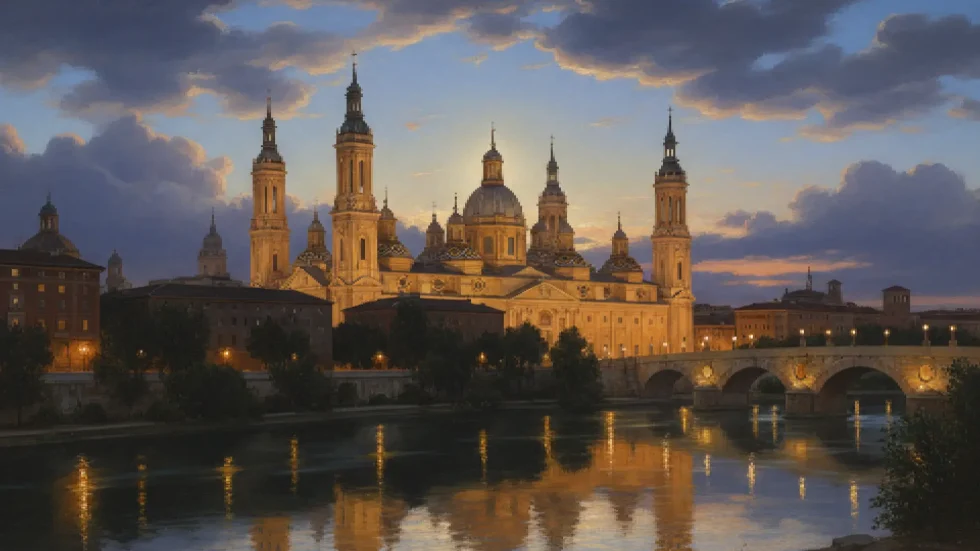
The grandeur of devotion to the Virgin of the Pillar is embodied in the magnificent Basilica that houses her image. This architectural masterpiece spans centuries of history and artistic styles, from its Visigothic origins to its current Baroque appearance. It is the second-largest basilica in Spain and one of Zaragoza’s most iconic landmarks.
Curiosities and Treasures of the Basilica:
- The Holy Pillar: The heart of the Basilica is the Holy Chapel, designed by Ventura Rodríguez, where the jasper column upon which the Virgin appeared is preserved. Despite the continuous contact of countless pilgrims over the centuries, the pillar has shown virtually no wear, a fact many consider miraculous. Pilgrims line up to kiss the Holy Column, protected by a bronze covering with openings that allow direct contact with the jasper. It is a profound moment of personal connection with the miracle.
- Goya’s Frescoes: The Basilica is a museum in itself, housing magnificent domes and vaults decorated by renowned artists. Among its greatest treasures are the frescoes painted by Francisco de Goya, especially the dome of Regina Martyrum (Queen of Martyrs) and the famous Coreto vault. Admiring these masterpieces is an unforgettable experience where faith and artistic genius meet.
- The Civil War Bombs: One of the most astonishing episodes in the Basilica’s history occurred during the Spanish Civil War. In 1936, three bombs dropped by Republican aircraft struck the Basilica. Remarkably, none of them exploded. Although they caused structural damage, neither the church nor the Holy Pillar was destroyed. Two of these unexploded bombs are still displayed inside the Basilica as testimony to what many believers consider divine protection.
- The Pilar Museum: The Basilica includes a museum displaying jewels, crowns, mantles of the Virgin (including historic pieces and donations from notable figures), ex-votos, and documents that tell the rich story of this devotion and the miracles attributed to Our Lady of the Pillar.
- The Ebro River and the Basilica: The Basilica is beautifully reflected in the waters of the Ebro River, creating one of Zaragoza’s most iconic views. From the Stone Bridge, the sight of the towers and domes—especially at sunrise or sunset—is among the most photographed scenes in Spain.
Visiting Our Lady of the Pillar: Rituals, Mantles, and Floral Symbolism
Visiting the Basilica of Our Lady of the Pillar is an experience that goes far beyond architectural admiration. It is an act of faith, a pilgrimage, and an immersion into a unique devotional culture.
How to Visit the Virgin and the Ritual of Kissing the Pillar
Upon entering the Holy Chapel, visitors are greeted by the image of the Virgin. One of the first things that draws attention is the mantle that covers her. The jasper pillar is fully visible only on the 2nd, 12th, and 22nd of each month, as well as on December 29th and October 12th (the Feast of Our Lady of the Pillar). During the rest of the year, the small image of the Virgin is covered with one of her many mantles.
The Mantles of the Virgin: A Living Heritage
The collection of mantles belonging to the Virgin of the Pillar is one of the most remarkable treasures of Marian devotion. The image is dressed daily in a different mantle, many of which have been donated by monarchs, popes, military institutions, dioceses, religious communities, and faithful devotees from around the world.
These mantles are much more than decorative garments. Each one carries a story of gratitude, faith, protection, or a fulfilled promise. Their colors, embroidery, heraldic symbols, and inscriptions reflect the cultural and spiritual richness of the communities that have entrusted their intentions to the Virgin’s intercession.
The Floral Offering: A Sea of Faith and Color

Every October 12th, Zaragoza celebrates one of the most moving religious events in Spain: the Floral Offering to Our Lady of the Pillar. Hundreds of thousands of people, dressed in traditional costumes from every region of Spain and many countries around the world, bring flowers to the Virgin throughout the day.
The flowers are carefully arranged on a large structure in Plaza del Pilar, forming an enormous floral mantle around the image of the Virgin. The result is a breathtaking mosaic of colors and fragrances that symbolizes the love, gratitude, and devotion of the people toward their Patroness.
For many families, participating in the Floral Offering is a cherished tradition passed down from generation to generation, strengthening both cultural identity and religious faith.
The Miracle of Calanda: The Most Famous Miracle of Our Lady of the Pillar

Among the many miracles attributed to the Virgin of the Pillar, none is more famous or more thoroughly documented than the Miracle of Calanda. This extraordinary event took place in the 17th century and remains one of the most remarkable miracles recognized by the Catholic Church.
The story centers on Miguel Juan Pellicer, a young farmer from Calanda, who lost his right leg after a serious accident. For more than two years, he relied on a wooden prosthesis while maintaining a deep devotion to Our Lady of the Pillar, frequently praying before her image in Zaragoza.
On the night of March 29, 1640, after fervently praying for the Virgin’s intercession, Miguel went to sleep in his family home. The following morning, his parents discovered something astonishing: the leg that had been amputated more than two years earlier had been completely restored. Not only had the limb reappeared, but it bore the same scars and marks that had existed before the accident.
The event caused an enormous stir throughout Spain. Civil authorities, medical professionals, witnesses, and Church officials conducted extensive investigations. Testimonies were collected from those who had seen Miguel after the amputation, as well as from those who had witnessed the miraculous restoration.
After careful examination, the miracle was officially recognized by ecclesiastical authorities. To this day, the Miracle of Calanda remains one of the most extraordinary and thoroughly documented miracles in Christian history, reinforcing devotion to the Virgin of the Pillar and her powerful intercession.
Why the Virgin of the Pillar Remains Relevant Today

The devotion to the Virgin of the Pillar continues to inspire millions of people across the world. Her message of perseverance, hope, and trust in God remains as meaningful today as it was nearly two thousand years ago when she appeared to Saint James.
For believers, the Pillar symbolizes steadfast faith amid life's difficulties. Just as the Virgin encouraged Saint James during a moment of discouragement, she continues to offer comfort and strength to those facing personal challenges, uncertainty, or suffering.
Every year, pilgrims travel to Zaragoza seeking spiritual renewal, healing, or simply the opportunity to pray before one of Christianity’s oldest Marian shrines. The Basilica remains a beacon of faith, welcoming people from every nation, culture, and background.
Conclusion
The Virgin of the Pillar is much more than a religious image or a historical devotion. She is a symbol of unwavering faith, maternal protection, and the enduring presence of God in the lives of His people.
From the miraculous apparition to Saint James and the extraordinary Miracle of Calanda, to the daily prayers of countless faithful, devotion to Our Lady of the Pillar continues to unite generations in a shared expression of faith and hope.
May the Virgin of the Pillar continue to guide, protect, and inspire all who seek her intercession, leading them ever closer to Christ through her loving maternal care.