
Shopping Cart

When attending Mass or any liturgical celebration in the Catholic Church, you have probably noticed that priests wear vestments of different colors: sometimes green, other times purple, white, or red. These colors are not random nor a matter of fashion; they are part of a visual language deeply rooted in the Church’s tradition, each carrying a liturgical meaning that helps us understand the liturgical season or feast being celebrated.
Understanding the meaning of liturgical colors is like opening a window into the heart of the faith. It allows us to immerse ourselves more fully in the Church’s annual cycle and in the mysteries of Christ’s life. In this article, we will explore what each color represents and when it is used, so that your participation in the liturgy may become more conscious and enriching.
What Are Liturgical Colors and Why Are They Important?
The liturgical colors are a coded system used by the Church in sacred vestments (chasubles, stoles, dalmatics, etc.) and sometimes in the decoration of the altar and church. Their main purpose is twofold:
- Indicating the Liturgical Season: Each color signals the period of the Church calendar we are in (Advent, Christmas, Lent, Easter, or Ordinary Time).
- Expressing the Nature of the Celebration: Colors communicate the character of the feast being celebrated, such as joy, penance, sacrifice, hope, or glory.
This “language of colors” has its roots in the early history of the Church. Although it developed gradually, it was formally codified in the Roman Rite through the Missal of Saint Pius V in the sixteenth century and later reaffirmed after the Second Vatican Council. Its importance lies in helping the faithful visualize and meditate upon the mystery of Christ being celebrated, fostering deeper participation in the liturgy.
The Meaning of Each Main Liturgical Color

Let us explore the principal colors and their profound liturgical significance:
1. Green: The Color of Hope and Ordinary Life
- Meaning: Green symbolizes hope, growth, life, and perseverance. It represents the period in which the Church reflects on Christ’s life and teachings, inviting us to grow in faith.
- Use: It is the color of Ordinary Time, the longest season of the liturgical year, divided into two periods: after Christmas until Lent, and after Easter until Advent. During this time, the Church focuses on the daily life and teachings of Christ.
2. Purple (Violet): The Color of Penance and Expectation
- Meaning: Purple is the color of penance, conversion, sobriety, and preparation. It calls us to reflection, repentance, and spiritual purification while also expressing hopeful expectation.
- Use: It is worn during Advent and Lent. It is also used in funeral Masses and in the Sacrament of Reconciliation.
3. White: The Color of Joy, Purity, and Glory
- Meaning: White is the color of Easter joy, purity, innocence, glory, and celebration. It symbolizes light, Christ’s Resurrection, and victory over sin and death.
- Use: It is used during the Christmas Season, the Easter Season, celebrations of the Lord (except those of His Passion), feasts of the Blessed Virgin Mary, angels, and non-martyr saints. It is also worn for Baptisms, First Communions, and Weddings.
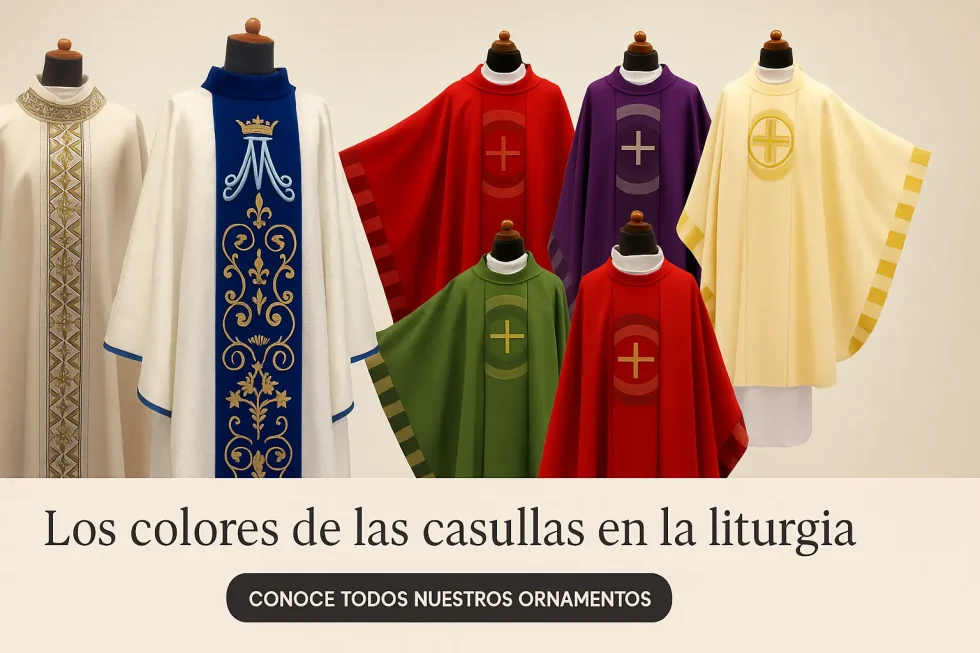
4. Red: The Color of Burning Love and Martyrdom
- Meaning: Red symbolizes the burning love of the Holy Spirit, the blood shed by Christ and the martyrs, and the fire of charity. It is a color of sacrifice, courage, and witness to the faith.
- Use: It is worn on Palm Sunday, Good Friday, and Pentecost Sunday (representing the fire of the Holy Spirit). It is also used on the feasts of the Apostles and Evangelists, as well as in celebrations of the martyrs.
Other Liturgical Colors and Special Uses
In addition to the four principal liturgical colors, there are several secondary colors and special exceptions used on particular occasions:
- Rose: Used only twice a year: on the Third Sunday of Advent (Gaudete) and the Fourth Sunday of Lent (Laetare). It softens the penitential character of violet and expresses joyful anticipation of Christmas or Easter.
- Black: Traditionally used for funeral Masses and Good Friday, symbolizing mourning. Today it has largely been replaced by violet, although its use remains permitted and is still maintained in some places.
- Blue: Although not an officially recognized universal liturgical color, it is permitted in certain countries and dioceses—especially in Spain and parts of Latin America—for celebrations of the Immaculate Conception and some Marian feasts because of its strong association with the Blessed Virgin Mary.
- Gold or Silver: These may replace other liturgical colors during particularly solemn celebrations such as Christmas, Easter, or major patronal feasts. They symbolize glory, majesty, and heavenly splendor.
Liturgical Colors and Their Relationship with Church Vestments

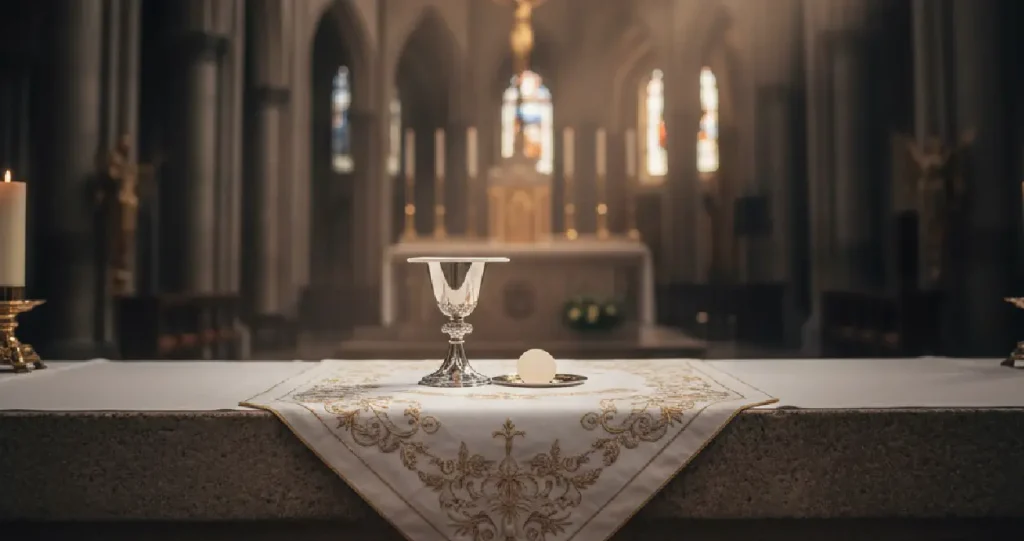
The symbolism of liturgical colors is made visible through the sacred vestments worn during the celebration of the liturgy. Among these vestments, the chasuble is the most recognizable, but the same liturgical color is also reflected in stoles, dalmatics, humeral veils, copes, altar frontals, and other ceremonial textiles.
For this reason, parishes and religious communities often maintain complete sets of vestments in the principal liturgical colors, ensuring that every celebration faithfully reflects the liturgical season and its spiritual significance.
Beyond their practical function, sacred vestments serve as a visual catechesis. Even before a word is spoken, the color of the vestments helps the faithful understand whether the Church is celebrating a season of joy, repentance, hope, sacrifice, or glory.
Why Liturgical Colors Still Matter Today
In a world dominated by images and visual communication, liturgical colors continue to be a powerful means of conveying the truths of the faith. They remind us that the liturgy is not merely a sequence of prayers but a living participation in the mysteries of Christ.
Each color invites us to adopt a particular spiritual attitude: hope during Ordinary Time, conversion during Lent, joyful expectation during Advent, celebration during Easter and Christmas, and courageous witness during feasts of martyrs and Pentecost.
By understanding the meaning behind these colors, the faithful can participate more consciously in the liturgy and deepen their appreciation for the Church’s rich spiritual and symbolic heritage.
Conclusion
The liturgical colors are much more than a decorative tradition. They are a profound visual language that accompanies the faithful throughout the liturgical year, helping them enter more deeply into the mysteries of salvation.
Whether through the green of hope, the violet of repentance, the white of glory, or the red of sacrifice, every liturgical color carries a message that enriches worship and strengthens the spiritual life of believers.
The next time you attend Mass, take a moment to observe the color of the vestments and reflect on its meaning. You may discover a new depth and beauty in the liturgy that has been there all along.